
What photographs matter after a trip over uneven pavement outside a Boca Raton business?
A trip over uneven pavement outside a Boca Raton business can be physically painful and mentally disorienting. After you make sure you’re safe and getting appropriate medical care, one of the most helpful (and time-sensitive) things you can do is photograph the scene before it changes.
Uneven sidewalks, pavers, asphalt patches, and curb transitions can look very different after a quick repair, pressure-washing, temporary cones, or even a change in lighting and weather. And in Florida trip-and-fall disputes, what often matters is not just “there was a defect,” but where it was, how visible it was, how big it was, and who likely controlled that stretch of walkway.
This guide is general information—not legal advice—and it’s written to help people in Boca Raton preserve clear, usable documentation without assuming wrongdoing by any person or business.
Related resources from Drazen Mancini, P.A. (internal links):
- Trip and Fall (Premises Liability)
- Commercial Property Injuries
- Palm Beach County Personal Injury Lawyer (Boca Raton office)
- Meet the Team
Drazen Mancini, P.A. can explain the issues involved in your trip and fall matter and help you understand the next step.
Why Boca Raton “where exactly” photos matter (more than a generic checklist)
A fall “outside a business” in Boca Raton can happen in several different legal and practical contexts:
- A private plaza walkway maintained by a landlord, management company, or contractor.
- A tenant-adjacent walkway where the lease allocates maintenance responsibilities.
- A public sidewalk/right-of-way that may be maintained by the City or another public entity.
- A mixed-control area (for example, a private drive aisle meets a public sidewalk; or a curb ramp meets a private entrance apron).
That’s why your photo set should do two jobs at once:
- Document the hazard (what caused the trip), and
- Lock in the map location (so the right owner/maintainer can be identified quickly).
Boca Raton also has practical local tools that can be relevant to documentation (for example, its online “Report a Concern” system for non-emergency infrastructure issues and its public maps/parcel viewer). If you choose to use those tools, it helps to understand that submissions may be visible publicly and may be subject to Florida public records law.
First: health and safety come before evidence
If you have serious pain, can’t bear weight, hit your head, feel confused, are dizzy, or your symptoms worsen, seek medical care promptly. Photos can support a claim, but they don’t diagnose an injury.
If you can take pictures safely, do so without stepping into traffic, standing in a drive aisle, or re-creating the fall. If you can’t, ask someone you trust to photograph the area while it still looks the way it did.
A Boca Raton uneven-pavement photo checklist (in the order that tends to help most)
Below is a practical shot list you can follow with a phone. If you can only do a few items, prioritize the ones marked (priority).
1) Establishing photos: prove the exact spot (priority)
Take wide photos that answer, “Where is this—exactly?”
- The storefront and entrance with the walkway in the frame.
- The address numbers (if posted) and any distinctive plaza signage.
- The walkway as it appears from both directions of approach.
- The nearest cross-street or intersection signage if visible.
Practical approach: take a “walk-in sequence” (far → mid → near → close-up). That makes it harder for anyone later to argue the defect is being photographed in a different location.
2) The hazard close-up: show the trip mechanism (priority)
Once the location is established, take close and medium shots that show what caught your foot:
- Straight-down close-ups (good for cracks, paver gaps, broken edges).
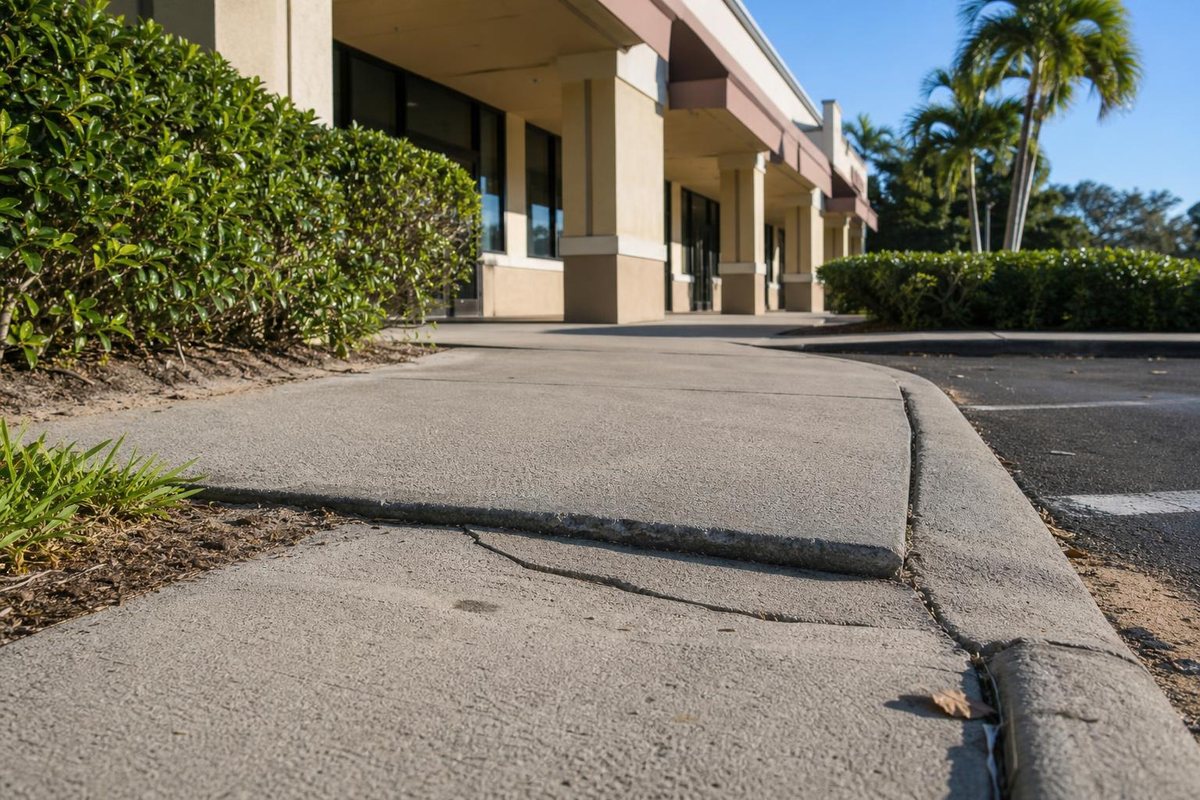
- Low side-angle shots (good for vertical “lips” and height changes).
- Medium shots showing the hazard’s position in the normal walking path.
If the surface is pavers, try to capture whether pavers are tilted, rocking, sunken, separated, or missing joint sand—details that are hard to remember later.
3) Measure it: photos that make size disputes harder (priority)
Size disputes are common in uneven-pavement cases. Use simple measurement/scale images:
- A tape measure, ruler, or even a coin next to the height difference.
- One photo with the measuring tool and one without it (to avoid the “the tool hid the defect” argument).
- Multiple measurements along the edge if the height varies.
If you don’t have a tape measure, take a photo with an object of known size (for example, a standard U.S. coin). It’s not as good as a ruler, but it can be better than nothing.
4) Visibility and “human viewpoint” photos: lighting, glare, shadows
Trip-and-fall disputes often become arguments about what was visible. Take photos from standing eye level:
- The walkway as it looks 5–15 steps before the hazard.
- The hazard at the moment it becomes visible.
- Any features that can change what a pedestrian sees: landscaping, parked cars, A-frame signs, menu boards, outdoor seating, or construction barricades.
If the fall happened at night, photograph nearby light fixtures, dark spots, and transitions. If it happened in the afternoon, capture strong shadows from trees, awnings, and columns.
5) Warnings and controls: cones, tape, paint, detours
Photograph any warnings—but also their placement and distance:
- Cones/signs in relation to your approach path.
- Barricades or tape from a wide enough angle to show whether a pedestrian could reasonably notice them.
- Painted markings, especially if paint is faded or partially worn away.
6) “Age and notice” details: document what the pavement shows
Without accusing anyone, you can preserve details that may later help answer whether a condition looks new or long-standing:
- Rounded edges, worn paint, repeated patches.
- Dirt/debris embedded in cracks.
- Vegetation growth through seams.
- Prior grinding marks or mismatched repair materials.
7) Your injuries and the progression
If appropriate and safe, photograph visible injuries:
- The same day (cuts, scrapes, immediate swelling).
- 24–48 hours later (bruising often develops later).
- Every few days for 1–2 weeks if swelling/bruising evolves.
Also photograph assistive devices prescribed later (boot, brace, crutches) and keep packaging/receipts when possible.
8) Footwear and personal items
Florida cases can involve comparative-fault arguments about footwear or distraction. Preserve what you were wearing and carrying:
- Soles/tread (close-up).
- Side view showing shoe type.
- Torn clothing, scuffs, or damaged personal property.
Local documentation tools in Boca Raton (and how to use them carefully)
If you’re trying to sort out whether the location might involve a public sidewalk or right-of-way, Boca Raton’s official mapping resources can help you confirm boundaries and the general area. The City’s “Maps” page includes access to a parcel viewer and other map documents. (External links: City of Boca Raton Maps; City limits map PDF.)
For private-property starting points, the Palm Beach County Property Appraiser provides public search and GIS mapping resources that can help identify parcel ownership records. (External links: PBC Property Appraiser search; PBCPA GIS / deed processing info.)
For safety-focused infrastructure reporting, Boca Raton’s “Report a Concern” system (My Boca / SeeClickFix) allows photo uploads and tracking. If you use it, be mindful that the City warns submissions may be publicly visible and may be subject to Florida public records requests. (External link: Report a Concern or Compliment; Florida public records statute: Fla. Stat. § 119.07 (2026).)
Keep your photos usable (don’t accidentally damage the evidence)
In Florida, photos generally must be authenticated—shown to be what they claim to be. In plain terms, you want to be able to say: who took the photo, when, and that it fairly depicts what it shows.
Practical steps that help:
- Keep original files (don’t overwrite them with edits).
- Avoid filters; if you add arrows/circles later, save that as a separate copy.
- Back up the original files to cloud storage and another device.
- Write down quick notes: date/time, exact location, direction you were walking, weather.
Florida’s Evidence Code contains an authentication requirement that is frequently relevant when photos are used in court. (External link: F.S. 90.901 (2026).)
If the pavement gets fixed after your fall, should you still photograph the repair?
Yes—documenting a repair can help show that the condition changed and why your original photos matter.
But Florida also has an evidence rule about “subsequent remedial measures” that can limit how a repair is used to prove negligence. In other words, a repair is not automatically an admission of fault, and the legal relevance depends on the purpose for which the repair evidence is offered. (External link: F.S. 90.407 (2026).)
The practical takeaway is simple: your best evidence is what you captured before anything changed.
Florida deadlines to keep in mind (especially if a public entity might be involved)
Many trip-and-fall claims are treated as negligence actions, and Florida’s statute of limitations for an action founded on negligence is two years. (External link: Fla. Stat. § 95.11 (2026).)
If the location could involve a government agency (for example, certain public sidewalks or public facilities), Florida’s sovereign immunity statute includes specific written notice requirements and timing rules that can apply before filing suit. (External link: F.S. 768.28 (2026).)
Because Boca Raton is in Palm Beach County, many local civil cases are in Florida’s Fifteenth Judicial Circuit. (External link: Florida Courts jurisdiction map (PDF).)
How Drazen Mancini can help after a fall outside a business
After a fall on uneven pavement outside a Boca Raton business, you may be dealing with painful injuries while the scene changes around you. Repairs, lighting changes, or the removal of a warning can make it harder to show what you encountered. At Drazen Mancini, P.A., we investigate the condition and work to preserve the available evidence.
We review photographs, surveillance footage, witness information, and relevant maintenance and inspection records. We examine who controlled the area and whether a business, landlord, property manager, or another party may be responsible. We also gather medical evidence to document your injuries and losses, and explain the options for resolving the claim through negotiations or litigation.
Our Boca Raton practice was established in 2026. Dan Drazen and Eugenio Mancini bring prior premises-liability and litigation experience, including trip-and-fall matters, to that work. A careful review still needs to establish what happened at this property rather than assume that a fall alone proves negligence.
Learn more about our firm and related services: Trip and Fall; Commercial Properties; Eugenio Mancini; Dan Drazen.
Questions About Trip And Fall?
Drazen Mancini, P.A. can explain the issues involved in your trip and fall matter and help you understand the next step.
Professional Profiles
WHAT OUR CLIENTS SAY
General feedback about working with Drazen Mancini, P.A.:
“Great people to work with who deliver real results!”
— A. C.
“Professional, knowledgeable, and easy to work with.”
— c. m.
FAQs about photographs after a Boca Raton uneven-pavement trip-and-fall (Florida)
Photographs are most useful when they answer specific questions a claim will raise later: where it happened, what caused the trip, how visible it was, and what changed afterward. The FAQs below focus on what to capture and why it can matter under Florida rules.
What wide-angle photos should I take to prove where the fall happened in Boca Raton?
Start with wide photos that make the location unmistakable. Take a “four-corners” set: face the storefront/entrance, then turn and photograph the view back toward the parking area or street, and repeat from the opposite direction of travel. Include stable reference points (address numbers, a plaza sign, a distinctive tree/planter, a curb line, a crosswalk, or a unique storefront) so the area can be re-identified even after repairs.
Then make your photos “map-ready.” Boca Raton boundaries and right-of-way responsibility can vary by block, so include the nearest intersection signage when possible. If the fall may involve a city sidewalk, it helps to capture the broader block so the location can later be cross-checked against official city maps and parcel viewers. Your goal isn’t to prove fault with one photo—it’s to prevent future disputes about the exact location.
Sources: City of Boca Raton: Maps | City of Boca Raton City Limits Map (PDF) | Palm Beach County Property Appraiser: PAPA Site Search
How do I photograph the height difference in a lifted sidewalk slab or paver edge?
Use a three-angle sequence to show both “what it is” and “how big it is.” First take a straight-down photo to capture the crack or offset cleanly. Next take a low angle shot from the direction you were walking so the raised lip is visible in context. Then take a side-profile shot as close as you can safely get without blocking the measurement.
For measurement, place a ruler or tape measure so the photo shows the higher surface, the lower surface, and a readable measurement in the same frame. Take one measurement photo and one “clean” photo without the tool. If the elevation change varies across a few inches (common with pavers), photograph two or three points along the edge. Even if accessibility rules don’t decide negligence by themselves, documenting a vertical change in level with an objective scale reduces arguments about whether the defect was “minor.”
Sources: 2010 ADA Standards for Accessible Design (PDF) | U.S. Access Board ADA Guide: Floor and Ground Surfaces | Florida Standard Jury Instructions in Civil Cases (PDF)
Should I photograph lighting, shadows, and glare, and why does that matter in Florida?
Yes—because uneven pavement cases often turn into visibility disputes. Take photos from standing eye level along the same approach path you used, not only close-ups taken after you already know where the defect is. If the fall happened at night, photograph nearby light fixtures, dark zones, and transitions (for example, leaving a bright interior and stepping into a dim exterior walkway). If it happened during the day, photograph heavy shadows from awnings, trees, columns, and parked cars.
Visibility documentation also matters because Florida uses a modified comparative fault system in many negligence cases. If an insurer argues you should have seen and avoided the condition, photos can help show what a reasonable pedestrian would have perceived in real time—especially when glare, shadow lines, or crowding obscured the surface. If you can safely return, “same time next day” photos can reduce arguments that your images don’t reflect actual conditions.
Sources: Fla. Stat. § 768.81 (2026) — Comparative Fault | Florida Standard Jury Instructions in Civil Cases (PDF) | City of Boca Raton: Streets and Sidewalks
What photos help show the condition existed long enough that someone might have discovered it?
Focus on details that can suggest whether a surface condition looks freshly created or more established—without making accusations. Take close-ups that show crumbling edges, rounded wear, embedded dirt, vegetation in seams, older paint remnants, repeated patch layers, and mismatched repair materials. Then take medium-range photos showing the defect’s placement in the natural walking path (for example, directly in the route from parking to the entrance), because “where it sits” can matter as much as “what it is.”
If your incident involved a temporary substance (like a spill) rather than pavement, Florida has a separate statute for “transitory foreign substances” in business establishments that focuses on proof of knowledge. Uneven pavement issues often fall outside that category, but the broader idea remains: clear photos can help preserve what the condition looked like before anyone cleans, patches, or re-levels it.
Sources: Florida Standard Jury Instructions in Civil Cases (PDF) | Fla. Stat. § 768.0755 (2026) — Transitory Foreign Substances | City of Boca Raton: Streets and Sidewalks
If the business fixes the pavement after my fall, what should I photograph?
Photograph the repair area in context: a wide shot showing where it sits relative to the storefront/entrance, then medium shots of the full repaired section, then close-ups of the surface texture (fresh concrete, new pavers, grinding marks, patched asphalt). Also photograph any new warnings—cones, tape, paint, or signs—and their placement relative to the approach path. Your goal is to document what changed, not to argue what the change “means.”
It’s also worth understanding that Florida has an evidence rule addressing “subsequent remedial measures.” Evidence of a post-incident repair is generally not used to prove negligence or culpable conduct, although it may be offered for other purposes (such as ownership or control, if disputed). That’s one reason your pre-repair photos can be so important: they preserve the condition as it existed when you fell.
Sources: F.S. 90.407 (2026) — Subsequent Remedial Measures | The Florida Bar Journal: Subsequent Remedial Measures | F.S. 90.901 (2026) — Authentication Requirement
How can I tell if the uneven pavement is a City of Boca Raton issue, and what photos help?
You usually can’t tell instantly just by looking. That’s why your photos should capture information that helps someone later map the exact location: street-name signs, the nearest intersection, crosswalk markings, curb ramps, and the boundary between the storefront area and the public pedestrian network. If the defect is near a driveway apron or curb cut, photograph the entire transition zone (wide and medium shots), because responsibility can change within a short distance.
If you’re reporting the issue for safety reasons, Boca Raton’s “Report a Concern” system allows you to submit photos and track status. If you use it, read the City’s notes about visibility and public records. If you believe a public entity may be legally involved in your injury claim, Florida’s sovereign-immunity statute has specific written notice rules and timing requirements that can apply, so it’s wise to get legal guidance early.
Sources: City of Boca Raton: Streets and Sidewalks | City of Boca Raton: Report a Concern or Compliment | F.S. 768.28 (2026) — Claims Against Government Entities
How long do I have to file a trip-and-fall lawsuit in Florida?
In many trip-and-fall situations against private parties, the claim is treated as a negligence action. Florida’s statute of limitations provides that an action founded on negligence must be started within two years. Because it can take time to identify who controlled the walkway (tenant, landlord, management company, maintenance contractor, or a public entity), it’s safer to treat investigation time as part of that two-year window—not something you start after you feel “done” with medical care.
If a city or other government agency may be involved, the analysis can change. Florida’s sovereign immunity statute includes pre-suit notice and a written denial framework that can affect timing and procedure. In Boca Raton and Palm Beach County, where public sidewalks can intersect with private shopping centers, early location documentation is often what helps confirm whether government-claim rules need to be evaluated.
Sources: Fla. Stat. § 95.11 (2026) — Limitations | F.S. 768.28 (2026) — Sovereign Immunity / Notice | Florida Courts Jurisdiction Map (PDF)
What injury photos matter if I hit my head or think I have a concussion?
Photograph visible signs of head impact (bruising, swelling, cuts) in good lighting from a few angles, and include one photo with a simple scale reference (like a ruler) if there’s a bump or laceration. Also preserve context photos of where your head may have struck (the pavement edge, curb, wall, or planter)—without re-enacting the fall. Because concussion symptoms are not always visible in a photo, keep a simple symptom timeline (headache, nausea, dizziness, light sensitivity, confusion) and note when symptoms started or worsened.
Most importantly, take head impacts seriously. CDC guidance emphasizes seeking emergency care for danger signs and getting evaluated if symptoms worsen. MedlinePlus likewise lists serious symptoms that call for urgent medical attention. Photos help document what you experienced, but they are not a substitute for medical assessment and follow-up.
Sources: CDC: Symptoms of Mild TBI and Concussion | CDC: What to Do After a Mild TBI or Concussion | MedlinePlus: Concussion
What photos matter if my ankle is swollen or I can’t put weight on it?
Take photos early and then again over time. Use a front, side, and back view of the ankle/foot, and include a scale item (ruler or tape measure) in at least one photo to show swelling. Try to keep the background and lighting consistent so progression is easier to compare. Also photograph any brace, boot, crutches, or walker you’re prescribed, because that equipment helps document functional limitations.
Severe pain, swelling, bruising, tenderness to touch, or inability to bear weight can be consistent with fractures (not just sprains). AAOS explains common ankle fracture symptoms and notes that X-rays are typically used for diagnosis. Clinical decision tools such as the Ottawa ankle rules are discussed in peer-reviewed medical literature as a way clinicians evaluate when radiographs may be appropriate after ankle trauma. If you can’t bear weight or symptoms worsen, seek prompt medical evaluation.
Sources: AAOS OrthoInfo: Ankle Fractures (Broken Ankle) | American Family Physician (PDF): Management of Ankle Sprains | MedlinePlus: Concussion
Can posting my fall photos on social media hurt my Florida trip-and-fall claim?
Florida evidence rules generally require authentication—showing that the photo is what you claim it is. The Florida Bar has published guidance discussing practical authentication issues for internet and social media evidence. The practical takeaway is consistent: keep originals, avoid filters on the originals, and assume anything you post publicly may become part of the dispute.
Sources: F.S. 90.901 (2026) — Authentication Requirement | The Florida Bar Journal: Social Media Evidence & Authentication | Fla. Stat. § 119.07 (2026) — Public Records
Ready to Discuss Your Trip And Fall Matter?
Drazen Mancini, P.A. can explain the issues involved in your trip and fall matter and help you understand the next step.
Related reading: Deferred Maintenance Is a Business Decision—Until It’s a Legal One

Related Drazen Mancini, P.A. Videos and Social Posts