How Do Lawyers Investigate a Crash Involving a Delivery Truck in Florida?
After a delivery-truck crash, you may be facing medical treatment, missed work, and conflicting accounts of what happened. A lawyer’s investigation brings together the scene evidence, truck records, witness accounts, and injury documentation to explain how the collision occurred and who may be responsible.
A truck backing out of a driveway presents different questions from a box truck running a red light or a delivery van stopping in a travel lane. The vehicle may belong to the driver, a local contractor, a retailer, or a separate fleet operator. A recognizable delivery logo helps identify leads, but it does not answer who employed the driver or which insurance policy covers the trip.
The investigation follows the truck’s movements, the driver’s work, and the consequences for you. Some records may need to be preserved quickly, while questions about responsibility and insurance require a closer review. Here is what that work involves and how you can help with the information already available to you.
STAND UP FOR OUR
CLIENTS.
Call or Click Now
Start with the collision, the vehicle, and the delivery assignment
The first conversation usually creates a timeline rather than a conclusion about fault. Where did the collision occur? Was the truck delivering, returning to a depot, or making a personal stop? Was it reversing, turning, pulling away from a curb, or traveling through an intersection? Who spoke with the driver, and what documents or photographs already exist?
A useful starting file includes the crash date and location, report number, driver information, license plate, vehicle photographs, witness contacts, medical providers, and insurance correspondence. A lawyer also needs to know whether either vehicle is at a tow yard, scheduled for repairs, or awaiting disposal. That information helps prioritize evidence that cannot easily be recreated later.
The vehicle identification number, ownership records, weight information, and delivery paperwork can help determine whether commercial-trucking regulations apply. Federal interstate rules use specific vehicle and operating definitions; Florida has its own provisions and exceptions for intrastate operations. A small delivery vehicle should not automatically be analyzed as though it were a long-haul tractor-trailer. 49 CFR § 390.5: Commercial motor vehicle definitions and Florida Statutes § 316.302: Commercial motor vehicle safety regulations supply the starting framework.
Preserve records before asking what they prove
Your lawyer can send focused preservation requests to the companies and people who may hold relevant evidence. The request identifies the crash, truck, driver, and time period so the recipient can locate the records. Depending on the collision, that may include the fleet operator, delivery contractor, vehicle owner, insurer, or a nearby camera operator.
- Original dashcam, doorbell, parking-lot, or business-camera recordings covering the approach and collision.
- Available GPS, fleet telematics, delivery scans, dispatch messages, and route assignments.
- The truck, damaged components, repair estimates, photographs, and records of any post-crash work.
- Applicable driver time records, inspection reports, maintenance history, and incident documentation.
Preservation and production are separate tasks. A request to retain footage can be made while counsel works out consent, an inspection agreement, or the appropriate litigation process for obtaining it. Florida Rule of Civil Procedure 1.350 addresses document, electronic-information, and physical inspection requests in litigation. Florida Rules of Civil Procedure, effective October 1, 2026.
The injured person has a role too: retain original photographs and recordings, keep correspondence, and avoid editing files or discarding damaged property before discussing inspection needs. Note where each item came from. A cropped screenshot may be useful for orientation, but the original file and surrounding footage can answer questions that the screenshot cannot.
Reconstruct the road movements with independent evidence
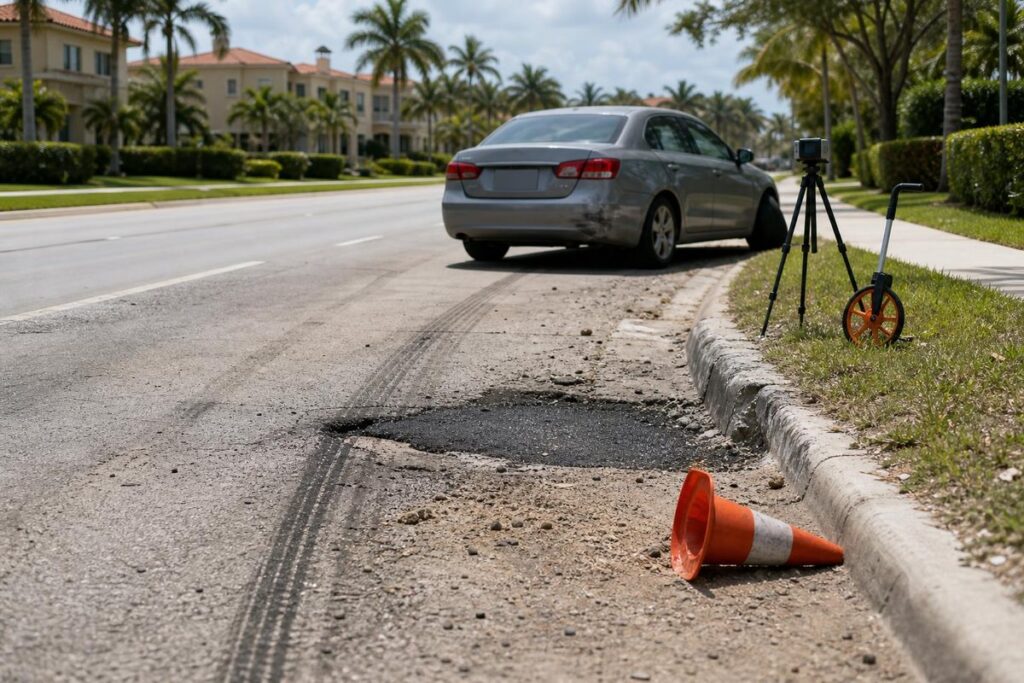
Your lawyer compares each driver’s account with the vehicle damage, debris, tire marks, final positions, road layout, and visibility. Witnesses may help fill in different parts of the sequence. Someone who saw the truck approaching may be able to explain its movement, while a person who arrived afterward may describe the scene and what the drivers said.
When the mechanics are disputed, an appropriate reconstruction specialist may examine whether the available measurements support a proposed speed, turn, braking sequence, or point of impact. The expert should identify assumptions and gaps. A view blocked by a parked vehicle, for example, may explain why two witnesses describe the same event differently.
Scene inspections, vehicle inspections, interviews, official reports, and available electronic data can help clarify a disputed collision. NHTSA’s Special Crash Investigations program brings these sources together in its investigations. Your lawyer can assess which evidence is available for your crash and whether a reconstruction expert is needed.
Sources: NHTSA: Special Crash Investigations.
The police report is another lead. It can identify people, vehicles, insurance information, and the investigating agency. It should be compared with the underlying evidence rather than treated as a civil judgment. Florida also restricts trial use of certain crash-report statements, so counsel must separate investigative usefulness from admissibility. Florida Statutes § 316.066: Written reports of crashes.
Read delivery data in context
Delivery records may help place the truck on a route and show the sequence of stops. A scan, dispatch message, or GPS point can raise a useful question: was the driver approaching a delivery address, rerouting, or communicating with a supervisor? The answer depends on what the system records and how reliably its timestamps align with other evidence.
A package scan does not necessarily prove where the vehicle was to the second, and a message timestamp does not by itself establish that the driver read it while moving. Investigators should examine the original export, available system explanations, time settings, and surrounding events. Ask which records this delivery business actually created and retained before relying on them.
Vehicle crash data is different from a delivery app or electronic driving log. NHTSA describes event data recorders as capturing a short window of technical information around a crash; available fields and limitations require careful interpretation. Lawyers should determine what this particular vehicle recorded and corroborate it with other evidence. NHTSA: Event Data Recorder.
If distraction is suspected, the inquiry should identify the specific interaction and its timing. Florida’s texting statute has defined prohibitions and exceptions, including navigation-related provisions. Calling something “app use” is too broad to establish a statutory violation or causation. Florida Statutes § 316.305: Wireless communications devices.
Check fatigue, maintenance, and loading without assuming a violation
A demanding route can justify questions about the driver’s workday, but a busy schedule does not prove fatigue caused the collision. Counsel may compare applicable time records with dispatch activity and witness evidence, then determine whether any relevant limit was exceeded. Local-delivery and interstate operations must be classified before selecting the rule.
Some drivers qualifying for a short-haul exception use time records instead of electronic logs. FMCSA expressly explains that qualifying timecard-exception drivers need not use ELDs. Florida’s intrastate statute adds important distinctions. The absence of an ELD therefore does not establish unlawful operation. FMCSA: Electronic logging devices and short-haul timecard exceptions; Florida Statutes § 316.302: Commercial motor vehicle safety regulations.
Vehicle condition calls for a similarly specific inquiry. A braking complaint should lead to examination of the brakes and relevant service history, not an assumption that every maintenance item contributed to the crash. Federal maintenance rules require covered carriers to systematically inspect, repair, and maintain vehicles and include record requirements in applicable circumstances. 49 CFR § 396.3: Inspection, repair, and maintenance.
If cargo movement or an obstructed view is implicated, photographs, loading documents, measurements, and witness accounts may help test that theory. The question is whether a proven condition affected the collision. A broken component found afterward may have failed before impact or may have been damaged by impact; the investigation needs to distinguish those possibilities.
Identify responsibility and available coverage separately
Lawyers investigate who hired and paid the driver, who controlled the work, who supplied the truck, and what the driver was doing at the time. Contracts, payroll information, dispatch instructions, and vehicle records can matter. A contractor label is a fact to examine alongside the actual working relationship, not a shortcut to a liability conclusion.
Florida’s civil jury instructions address employee status and conduct within the scope of employment among vicarious-liability issues. They provide a reason to examine the relationship carefully. A vehicle owner’s role or a maintenance provider’s conduct may raise other questions, but each proposed defendant needs a supported legal basis for responsibility. Florida Standard Jury Instructions in Civil Cases: Negligence and vicarious liability.
Insurance is a related but distinct investigation. Section 627.4137 provides a written-request process for disclosure of potentially applicable liability policies, including known excess or umbrella coverage. Policy terms, insured identities, limits, and asserted defenses should be checked rather than inferred from the size of a delivery brand. Florida Statutes § 627.4137: Disclosure of insurance information.
Document the injury claim while fault is being investigated
An investigation can establish how a truck moved without establishing the extent of someone’s injuries. Medical records, bills, treatment chronology, employment records, and evidence of daily limitations help address that separate issue. Prior conditions should be discussed honestly so counsel and treating professionals can distinguish the person’s earlier health from changes after the crash.
Keep a factual record of appointments, missed work, expenses, and activities affected by the injury. Do not substitute a personal diary for a medical assessment or assume a future expense is certain without support. Where Florida PIP applies, the statute ties eligibility for medical benefits to qualifying initial services within 14 days; it is not a reason to delay necessary care. Florida Statutes § 627.736: Required personal injury protection benefits.
Fault disputes also matter. For negligence actions governed by Florida’s current comparative-fault statute, recovery is reduced by the claimant’s share of fault, and a claimant more than 50 percent responsible for their own harm cannot recover damages. That makes evidence of both drivers’ conduct important. Florida Statutes § 768.81: Comparative fault.
Florida generally gives current negligence claims a two-year filing period, but the applicable deadline requires review of the claim, accrual date, and any exceptions. Counsel should calculate it rather than assume negotiations extend it. Evidence preservation should begin well before the filing deadline. Florida Statutes § 95.11: Limitations other than for recovery of real property.
How Drazen Mancini can help after a delivery-truck crash
After a delivery-truck crash, you may be dealing with injuries while the driver, company, and insurers disagree about responsibility. Drazen Mancini, P.A. handles truck accident claims and works to identify available evidence, investigate who may be responsible, and document the injuries and losses you have suffered.
We can review witness information, vehicle damage, available footage, and relevant company records. When evidence is controlled by another party, the investigation may require formal requests and litigation. We prepare the claim carefully and keep you informed about what is known, what remains disputed, and what additional evidence is needed.
Dan Drazen brings experience in trucking matters, depositions, court proceedings, and trial preparation. Eugenio L. Mancini, Jr. has handled thousands of pre-litigation matters and hundreds of litigated matters involving car accidents and slip-and-fall cases, and serves clients in English and Spanish. The partners brought that earlier experience to Drazen Mancini, P.A., established in 2026. For someone injured in a delivery-truck crash, careful case preparation and clear communication can help make a complicated claim easier to understand.
Bring the crash information and treatment records you already have. We can discuss evidence that needs prompt attention, investigate the parties involved, and explain your options for negotiations or litigation. Every case depends on its own evidence, and past results do not guarantee a similar outcome.
Related resources
- Drazen Mancini, P.A.: Dan Drazen attorney profile
- Drazen Mancini, P.A.: Eugenio Mancini attorney profile
STAND UP FOR OUR
CLIENTS.
Call or Click Now
Related Drazen Mancini resources
These firm resources provide additional background on truck claims and the attorneys available to discuss an investigation:
Florida Delivery-Truck Crash Investigation FAQs
These answers provide general information about Florida investigations and claims. The applicable law, available evidence, and insurance depend on the particular crash; this information is not individualized legal advice.
Can my lawyer obtain a crash report before the public can?
Yes. Florida permits crash participants and their legal representatives to obtain qualifying reports during the initial confidentiality period. Section 316.066 generally protects reports containing specified personal information for 60 days after filing, but it also identifies authorized recipients who can receive them sooner. Counsel must follow the agency’s identification and access requirements.
The report can guide witness and vehicle inquiries while other evidence is gathered. It does not settle civil fault, and protected statements made for a required crash report have trial-use restrictions. A lawyer should corroborate the report with photographs, recordings, and independent accounts instead of waiting for general public release to begin investigating.
Sources: Florida Statutes § 316.066: Written reports of crashes; NHTSA: Special Crash Investigations.
Does every delivery truck have to use an electronic driving log?
No. Whether an electronic logging device is required depends on the vehicle, operation, and applicable exceptions. FMCSA explains that drivers using qualifying short-haul timecard exceptions are not required to keep records of duty status or use ELDs. Relevant time records may still exist even when no electronic driving log is required.
An investigator should ask which exception the operator relied on and check whether its conditions were satisfied. Florida intrastate provisions must also be examined rather than automatically applying interstate assumptions. Dispatch activity and delivery records may provide additional context, but the absence of an ELD alone is not evidence that the driver broke a rule.
Sources: FMCSA: Electronic logging devices and short-haul timecard exceptions; 49 CFR § 395.1: Scope and short-haul exceptions; Florida Statutes § 316.302: Commercial motor vehicle safety regulations.
Can a delivery scan prove that the driver was distracted?
No. A delivery scan alone does not prove distraction or show that distraction caused a crash. The investigation needs to establish what the timestamp represents, who performed the action, and whether it occurred while the vehicle was moving. Any conclusion should be checked against footage, witness accounts, and other available records.
Florida’s texting statute addresses specified nonvoice communications and contains exceptions, including navigation-related provisions. A lawyer therefore needs to identify the actual conduct rather than treat every app interaction as the same offense. Technical crash data may help reconstruct vehicle movement, but it does not automatically identify what a driver was looking at or thinking.
Sources: Florida Statutes § 316.305: Wireless communications devices; NHTSA: Event Data Recorder.
Can I recover damages if I was partly at fault?
Possibly. In a negligence action covered by Florida’s comparative-fault statute, a claimant’s fault reduces the damages awarded, while fault greater than 50 percent for the claimant’s own harm bars recovery. The percentage cannot responsibly be determined from one driver’s accusation or an insurer’s opening position.
Counsel should examine both vehicles’ movements, visibility, and the evidence supporting any allegation of unsafe conduct. A witness account may be important but still needs context about what the witness actually observed. This is one reason to preserve scene and vehicle evidence even when the delivery driver initially accepts responsibility; the available evidence may later be disputed.
Sources: Florida Statutes § 768.81: Comparative fault; NHTSA: Special Crash Investigations.
How long do I have to file a Florida delivery-truck injury lawsuit?
Florida generally provides two years for a current negligence claim, but the precise deadline depends on the cause of action and when it accrued. Section 95.11 supplies limitation periods, while section 95.031 addresses computation of time. Different theories and legally applicable exceptions need individual review.
The filing deadline is not a schedule for waiting to collect evidence. Ask counsel to calculate the deadline from the actual facts and identify any additional requirements. An ongoing insurance discussion should not be assumed to pause the clock. Preserve the crash date, correspondence, and documents needed to evaluate timing while the investigation is underway.
Sources: Florida Statutes § 95.11: Limitations other than for recovery of real property; Florida Statutes § 95.031: Computation of time.
How does a lawyer find the truck’s insurance coverage?
A lawyer can use Florida’s written insurance-disclosure process to request information about potentially applicable liability coverage. Section 627.4137 requires a qualifying insurer to provide specified information within 30 days of the claimant’s written request, including known excess or umbrella policies. The response can identify coverage questions that need further investigation.
The truck’s branding is not a substitute for checking insured names, policy terms, and the roles of the driver and operator. Florida civil procedure also addresses discovery of relevant insurance agreements in litigation. Coverage and responsibility are separate questions: locating a policy does not itself prove that an insured party caused the crash or that every claimed loss is covered.
Sources: Florida Statutes § 627.4137: Disclosure of insurance information; Florida Rules of Civil Procedure, effective October 1, 2026.
What if the truck is repaired before anyone inspects it?
Repairs can make it harder to examine the original damage or a suspected mechanical problem, but they do not automatically defeat a claim. Counsel should determine what photographs, estimates, service records, removed parts, and other evidence remain. Scene measurements and witness accounts may still help explain the collision.
Prompt communication about the truck’s location and planned work can help counsel seek an agreed inspection or appropriate litigation relief. Covered carriers have maintenance obligations, but a recordkeeping rule does not ensure every damaged part will remain available. No one should interfere with a vehicle or access another person’s property without permission or lawful authority; preservation should proceed through proper channels.
Sources: 49 CFR § 396.3: Inspection, repair, and maintenance; NHTSA: Special Crash Investigations.
Does an independent-contractor label mean the delivery company cannot be responsible?
No. A label alone does not resolve every responsibility question. Counsel should examine the working relationship, the relevant degree of control, and what the driver was doing when the crash occurred. Florida’s civil jury instructions address employee and independent-contractor distinctions among issues that can affect vicarious liability.
The investigation should obtain facts rather than assume the best-known company in the delivery chain is liable. The driver, vehicle owner, operator, and other entities may have different roles. Florida’s comparative-fault law also makes allocation of responsibility important when multiple parties are involved. Any claim against a company needs a supported legal theory tied to its relationship or conduct.
Sources: Florida Standard Jury Instructions in Civil Cases: Negligence and vicarious liability; Florida Statutes § 768.81: Comparative fault.
Do I have to finish investigating fault before using PIP benefits?
No. When Florida PIP coverage applies, benefits are generally payable without resolving who caused the crash, subject to the statute’s coverage and benefit requirements. Qualifying initial medical services within 14 days matter for medical-benefit eligibility. Counsel should check the applicable policy and statutory conditions while the liability investigation proceeds.
Medical treatment decisions belong with qualified health professionals, and records of that care also help document the injury claim. Keep bills, explanations of benefits, and insurer correspondence so payments and remaining expenses can be understood. PIP and a liability claim serve different functions; receiving a benefit does not establish the delivery driver’s responsibility or settle all recoverable losses.
Sources: Florida Statutes § 627.736: Required personal injury protection benefits; Florida Statutes § 627.731: Purpose of no-fault benefits.
Does missing camera footage automatically mean I win the case?
No. Missing footage does not automatically establish liability or entitle someone to judgment. Florida Rule of Civil Procedure 1.380(f) sets conditions for remedies when electronically stored information that should have been preserved is lost. The inquiry includes preservation steps, replacement possibilities, prejudice, and, for certain severe measures, intent to deprive another party of its use.
A lawyer should establish who controlled the recording, whether it existed, and what happened to it, while seeking other available evidence. NHTSA’s investigative model uses multiple sources precisely because one record rarely answers every question. A preservation request is useful, but it is not a guarantee that footage exists, will be produced, or will prove the anticipated account.
Sources: Florida Rules of Civil Procedure, effective October 1, 2026; NHTSA: Special Crash Investigations.
STAND UP FOR OUR
CLIENTS.
Call or Click Now
Related reading: Drazen Mancini, P.A. Urges Caution and Patience Following Reports of Rollover Crash Involving Tiger Woods