Palm Beach County FL Personal Injury Lawyer
An injury can disrupt your health, your income, and your family’s routine all at once. While you are trying to recover, insurers may already be asking for statements, reviewing your medical history, and looking for reasons to reduce what they pay.
Drazen Mancini, P.A. represents injured people throughout Palm Beach County from its office in Boca Raton FL. The firm helps clients identify who was responsible, preserve evidence, deal with insurance companies, and understand what comes next.
Boca Raton FL Injury Practice Areas
Why Injured People Turn to Drazen Mancini, P.A.
If your medical bills are growing or an insurer is disputing fault, you need more than general information. You need lawyers who can evaluate the evidence, explain the difficult parts of your case, and prepare it as though it may eventually be tried.
Founding partner Eugenio Mancini has handled thousands of pre-litigation matters and hundreds of cases in litigation. He works with clients in English and Spanish. Dan Drazen has experience handling motor vehicle collisions, trucking cases, falls, dog bites, nursing home abuse, and other injury claims, including depositions and courtroom proceedings.
The firm’s published case results include recoveries in a rear-end collision, a disputed-liability motor vehicle case, and a bicyclist’s pothole claim. Those cases illustrate an important point: a successful claim often depends on details that are easy to overlook, such as road control, maintenance history, vehicle movement, and early evidence preservation.
Drazen Mancini offers free consultations and handles injury claims on a contingency basis. That means the firm does not charge a legal fee unless it obtains a recovery for you.
Palm Beach County Areas Served
Personal Injury
Car Accidents
Questions about an injury in Palm Beach County?
Drazen Mancini, P.A. offers a free consultation so you can ask questions before deciding what to do.
Why Palm Beach County Injury Cases Require Local Investigation
Palm Beach County is not one traffic or property environment. A crash on I-95 presents different evidence and ownership questions than a collision on a municipal street, a fall in a Boca Raton shopping center, or an injury on a western county road.
There are 39 incorporated municipalities in Palm Beach County, along with large unincorporated areas. A roadway, sidewalk, traffic signal, drainage system, or public property may be controlled by a city, Palm Beach County, the state, another public authority, or a private contractor. That distinction can determine:
- Where maintenance and inspection records are kept
- Which agency received earlier complaints
- Whether government-claim rules apply
- Who may possess video or traffic-control data
- Which insurance policies may cover the loss
Road ownership is not always obvious from the location alone. FDOT District Four covers Palm Beach County, while the county’s Engineering and Public Works Department manages other roads, traffic systems, and transportation records. Municipalities and private property owners may control still other locations.
A lawyer should settle those questions early, before records are overwritten, conditions change, or the wrong party receives notice.
A Local Accident Snapshot
The numbers do not tell any one person’s story, but they show why the exact location and manner of an accident matter:
- Palm Beach County recorded 26,550 motor vehicle crashes in 2024, according to data published by the Florida Department of Health and sourced from FLHSMV.
- Between 2019 and 2023, Palm Beach County recorded 997 traffic deaths.
- During the same five-year period, the county recorded 4,396 incapacitating injuries.
- Pedestrians, bicyclists, and other vulnerable road users represented 43% of traffic fatalities despite accounting for approximately 3% of travel mode share.
- Intersection-related collisions accounted for 40% of fatal and serious-injury crashes.
- The county identified a 276-mile High Injury Network—about 4% of roadway miles—that accounted for 38% of fatal crashes and 36% of serious-injury crashes.
These findings come from the Palm Beach County Vision Zero crash analysis and the state’s 2024 motor vehicle crash data.
The practical lesson is straightforward: severe crashes are not spread evenly across the county. Road design, speed, lighting, intersection geometry, pedestrian activity, and maintenance can all become part of the liability investigation.
Where Serious Injuries Happen in Palm Beach County
Many local injury cases begin on high-volume, multilane roads where vehicles enter from shopping centers, residential communities, and side streets. Left turns, lane changes, short merging areas, and pedestrian crossings can produce conflicting accounts about who had the right of way.
Other cases happen in places where the hazard may disappear within minutes:
- A spill is cleaned after a grocery-store fall.
- A damaged floor mat is moved after someone trips.
- A pothole is patched following a bicycle crash.
- Merchandise is removed from a store aisle.
- A broken light is replaced after an assault or fall.
- Vehicles are repaired or sold before they can be inspected.
Palm Beach County’s adopted Safety Action Plan recognizes that the most severe crashes are concentrated along certain roads and intersections. For an injured person, that makes scene photographs, measurements, prior crash information, traffic plans, and maintenance records particularly important.
Personal Injury Cases Drazen Mancini Handles
Drazen Mancini represents people injured in cases involving:
- Car and other motor vehicle accidents
- Commercial truck accidents
- Motorcycle accidents
- Uber and Lyft accidents
- Premises liability claims
- Slip-and-fall accidents
- Trip-and-fall accidents
- Big-box retail store accidents
- Commercial property accidents
- Wrongful death claims
The person who caused the immediate accident is not always the only responsible party. A commercial driver’s employer, property management company, maintenance contractor, vehicle owner, rideshare platform, security company, or government agency may also need to be investigated.
What to Do After an Accident
Your health comes first. Seek emergency help when necessary, and do not assume that an injury is minor simply because the pain has not fully developed.
Once you are safe, take the following steps when possible:
- Report what happened. Call law enforcement after a traffic crash. Report a property injury to the manager, owner, or security department and ask how to obtain the incident report.
- Get medical care. Prompt treatment protects your health and creates a record connecting your condition to the accident. After a motor vehicle crash, Florida’s PIP law generally requires initial care within 14 days.
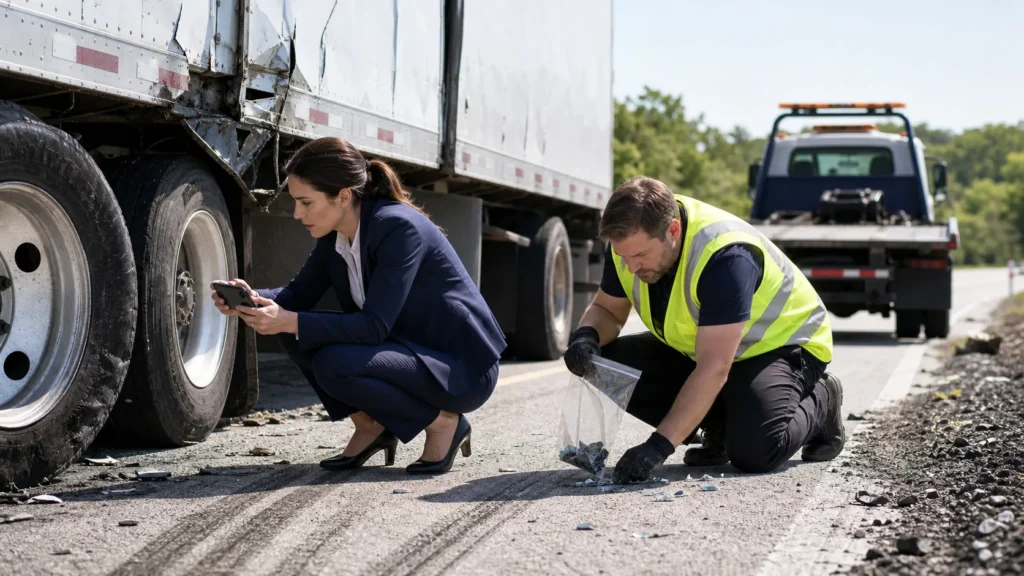
- Photograph the scene. Include the overall area, the hazard, vehicle positions, damage, skid marks, warning signs, lighting, weather conditions, and anything blocking your view.
- Identify witnesses. Get names and contact information. A witness may leave before police or management finishes preparing a report.
- Preserve damaged property. Do not discard shoes, clothing, helmets, child seats, damaged products, or other physical evidence.
- Be careful with insurance calls. You may have duties under your own policy, but you do not need to guess, minimize your injuries, or give a detailed recorded statement to the other side’s insurer before understanding your position.
- Keep a complete file. Save medical bills, discharge papers, prescription receipts, repair estimates, work notes, mileage records, and insurance correspondence.
You do not need to investigate the entire case yourself. You do need to avoid losing evidence that may not be replaceable later.
Evidence That Can Strengthen a Personal Injury Claim
The most useful evidence depends on what happened.
After a vehicle crash, the investigation may involve:
- Police reports and 911 recordings
- Vehicle photographs and inspections
- Event data recorder information
- Traffic-signal timing and roadway plans
- Driver phone records
- Commercial driving and maintenance records
- Rideshare app status and trip data
- Nearby business or residential video
After a fall or other property injury, important evidence may include:
- Surveillance footage
- Incident reports
- Inspection and cleaning logs
- Maintenance requests
- Photographs and measurements of the hazard
- Employee schedules and witness statements
- Earlier complaints or similar incidents
Florida law requires someone injured by a temporary substance in a business to prove that the business had actual or constructive knowledge of the condition. Constructive knowledge may be shown by evidence that the condition existed long enough that the business should have discovered it or that it happened regularly enough to be foreseeable. That is why store video and inspection records can be central to a Florida slip-and-fall case.
Medical evidence matters just as much. A complete claim should explain not only your diagnosis, but how the injury affects your work, mobility, sleep, independence, and future care.
Florida Insurance Rules After a Motor Vehicle Accident
Florida’s insurance system can be confusing because several forms of coverage may apply to the same crash.
Personal Injury Protection
Florida PIP generally provides up to $10,000 in medical and disability benefits. It pays 80% of qualifying medical expenses when initial care is received within 14 days. The available medical benefit may be limited to $2,500 unless an authorized provider determines that the person suffered an emergency medical condition.
The full requirements appear in Florida Statutes § 627.736.
Claims Against the At-Fault Party
PIP does not necessarily cover the full cost of an injury. Depending on the circumstances, additional recovery may come from:
- The negligent driver’s bodily injury coverage
- Uninsured or underinsured motorist coverage
- A commercial vehicle policy
- An employer’s liability coverage
- Rideshare insurance
- A vehicle owner’s coverage
- Other responsible parties
Florida also limits when a motor vehicle claimant may recover damages for pain, suffering, mental anguish, and inconvenience. Those damages generally require a permanent injury, significant and permanent loss of a bodily function, significant permanent scarring or disfigurement, or death under Florida Statutes § 627.737.
The insurer’s view of whether an injury is permanent is not necessarily the final answer. Medical opinions and the long-term course of treatment can be decisive.
How Long Do You Have to File a Claim?
Florida generally allows two years to file an action founded on negligence. Wrongful death actions also generally have a two-year deadline. These periods are set out in Florida Statutes § 95.11.
That does not mean waiting two years is safe.
Surveillance footage may be erased in days or weeks. Vehicles may be repaired. Witnesses move. A hazardous condition may be corrected. Insurance policies can contain separate notice requirements, and claims involving public entities have additional procedures.
The deadline can also depend on when the incident occurred and the legal theory involved. If you are unsure which rule applies, ask sooner rather than later.
Get clear answers about fault, insurance, and next steps.
Talk through your options with Drazen Mancini, P.A..
What If You Were Partly at Fault?
Florida follows a modified comparative-fault rule in most negligence cases. If you are assigned some responsibility, your recovery may be reduced by that percentage.
If you are found more than 50% at fault for your own harm, you generally cannot recover damages. The greater-than-50% bar does not apply to medical negligence claims. The rule appears in Florida Statutes § 768.81.
Fault disputes often begin early. A driver may claim you changed lanes. A store may say you should have seen the spill. A property owner may argue that the hazard was obvious. An insurer may use a recorded statement, incomplete report, or isolated photograph to shift responsibility.
Those arguments should be answered with evidence—not assumptions.
Who May Be Liable?
Depending on the case, responsible parties may include:
- A careless driver
- The owner of a vehicle
- A driver’s employer
- A trucking company or maintenance provider
- A property owner or tenant
- A business operating on the property
- A landlord or property management company
- A cleaning, repair, landscaping, or security contractor
- A rideshare driver or applicable insurer
- A city, county, transit agency, or state department
- A contractor performing public work
Identifying every responsible party matters because each may have different records, insurance, defenses, and legal obligations.
Compensation Available After an Injury
A personal injury claim may seek payment for losses such as:
- Emergency care and hospitalization
- Surgery, therapy, medication, and rehabilitation
- Future medical treatment
- Lost income
- Reduced earning capacity
- Property damage
- Physical pain
- Emotional suffering
- Disability, scarring, or disfigurement
- Loss of normal activities
In a fatal case, Florida’s Wrongful Death Act may allow the personal representative to pursue losses suffered by the estate and qualifying survivors. The recoverable damages depend on the deceased person’s relationships, financial contributions, medical expenses, funeral costs, and other case-specific factors.
A responsible evaluation should consider the future, not just the bills that have arrived so far.
Claims Involving Palm Beach County or Another Public Entity
An accident involving a public vehicle, Palm Tran bus, public building, government-maintained sidewalk, traffic signal, or state or county road may involve Florida’s sovereign-immunity law.
These cases can require written notice to the correct agency before a lawsuit is filed. For many tort claims, notice must be presented within three years. Wrongful death claims generally have a two-year notice period. A denial or waiting process may also apply.
Florida law generally limits the amount a government entity must pay to $200,000 per person and $300,000 per incident, although insurance and legislative procedures may affect what happens in a particular case. The requirements and limits appear in Florida Statutes § 768.28.
A government-owned location does not automatically create a valid claim. The investigation must still establish negligence, causation, and damages. It must also identify the correct entity. A road may pass through a city without being maintained by that city, and a private contractor may have performed the work that created the hazard.
If a public agency may be involved, do not wait to determine which procedures apply.
Local Courts, Medical Records, and Public Agencies
Personal injury lawsuits arising in Palm Beach County are generally handled through the Fifteenth Judicial Circuit. Where a case is filed can depend on the defendants, the amount in dispute, and where the events occurred.
Medical records may come from several sources even after one accident: fire-rescue personnel, an emergency department, imaging facilities, specialists, physical therapists, and pharmacies. Keep a list of every provider you see. Missing records can make an injury appear less serious or create an unexplained gap in treatment.
Other local records may be held by:
- The Palm Beach County Sheriff’s Office
- A municipal police department
- Palm Beach County Fire Rescue or a municipal fire-rescue department
- Palm Beach County Engineering and Public Works
- FDOT District Four
- A city public works or risk-management department
- A transit authority or private transportation operator
The agency that responded to the accident may not be the agency responsible for the road or property. Both questions must be investigated.
How Drazen Mancini Investigates an Injury Case
A careful investigation begins by listening to what happened and identifying what could disappear.
Depending on the claim, the firm may:
- Review photographs, reports, medical records, and insurance policies.
- Determine who owned or controlled the accident location.
- Send preservation notices for video, vehicles, app data, logs, and other evidence.
- Obtain public records from law enforcement and transportation agencies.
- Interview witnesses before memories fade.
- Examine prior complaints, inspections, repairs, or similar incidents.
- Document lost income and the effect of the injury on daily life.
- Consult medical, reconstruction, engineering, or financial professionals when necessary.
- Present the claim to the responsible insurers.
- File a lawsuit and prepare for trial if the insurer will not respond fairly to the evidence.
Preparation changes negotiations. An insurer is more likely to take a claim seriously when the responsible parties have been identified, the evidence is preserved, and the damages are supported.
Frequently Asked Questions
Do I have a case if the other person was not ticketed?
Possibly. A traffic citation is not required to bring a civil injury claim. The police report is one piece of evidence, but photographs, witnesses, video, vehicle data, and traffic records may provide a more complete account.
What if I did not feel injured immediately?
Some injuries become more noticeable after adrenaline wears off. Seek medical care if you develop pain, dizziness, numbness, headaches, weakness, or other symptoms. After a motor vehicle crash, remember that Florida’s PIP law generally requires initial treatment within 14 days.
Should I sign the insurance company’s medical authorization?
Read it carefully. A broad authorization may allow an insurer to obtain years of unrelated medical information. Before signing, ask what records are being requested and why.
How much is my personal injury case worth?
The value depends on liability, insurance coverage, the seriousness and permanence of the injury, medical needs, lost income, comparative fault, and how the injury affects your life. A meaningful estimate usually requires medical records and an investigation of the available coverage.
Will my case go to court?
Not necessarily. Many cases resolve through insurance negotiations. Filing a lawsuit may become necessary when fault is disputed, the insurer undervalues the injuries, evidence must be obtained through subpoenas, or the parties cannot agree on fair terms.
How much does it cost to contact Drazen Mancini?
The firm offers a free consultation. Drazen Mancini handles injury matters on a contingency basis, meaning there is no legal fee unless the firm obtains a recovery.
What happens when I call?
You can tell the firm what happened, when and where it occurred, what treatment you have received, and which insurers have contacted you. The attorneys can then explain the issues they see, the evidence that may need to be protected, and the next steps available.
You do not need to know the legal name of your claim before calling.
Related Resources
- Drazen Mancini Practice Areas
- Auto Accident Attorneys
- Premises Liability Attorneys
- Wrongful Death Attorneys
- Meet the Drazen Mancini Team
- Personal Injury Case Results
Tell Us What Happened
You may be unsure who was responsible, which insurance policy applies, or whether your injury is serious enough to justify a claim. You do not need to answer those questions alone.
Contact Drazen Mancini, P.A. for a free consultation. The firm’s office is located at 1489 W Palmetto Park Road, Suite 500, Boca Raton FL 33486.
Call 561-783-4534. Ask your questions. The firm will explain your options and what may need to be done to protect the evidence.
Talk with Drazen Mancini, P.A.
Call 561.783.4534 or request a free consultation.
Sources
Drazen Mancini, P.A.
- Drazen Mancini, P.A.
- Drazen Mancini Practice Areas
- Dan Drazen Attorney Profile
- Eugenio Mancini Attorney Profile
- Drazen Mancini Case Results
- Auto Accidents
- Truck Accidents
- Motorcycle Accidents
- Rideshare Accidents
- Premises Liability
- Slip and Fall Accidents
- Trip and Fall Accidents
- Big-Box Retailer Accidents
- Commercial Property Accidents
- Wrongful Death
- Contact Drazen Mancini
- Drazen Mancini Contingency-Fee Statement
Palm Beach County and Florida Agencies
- Palm Beach County Municipalities
- Palm Beach County Engineering and Public Works Traffic Division
- Palm Beach County Safety Action Plan
- Palm Beach County Vision Zero Crash Analysis
- Florida Department of Health 2024 Motor Vehicle Crash Data
- Florida Department of Transportation Districts
- Fifteenth Judicial Circuit
Florida Law
- Florida Statutes § 95.11 — Limitations of Actions
- Florida Statutes § 627.736 — Personal Injury Protection
- Florida Statutes § 627.737 — Motor Vehicle Injury Threshold
- Florida Statutes § 768.0755 — Transitory Foreign Substances
- Florida Statutes § 768.28 — Government Tort Claims
- Florida Statutes § 768.81 — Comparative Fault